Overview
What is VMEC?
VMEC (Variational Moments Equilibrium Code) computes ideal-MHD equilibria in toroidal geometry by representing flux surfaces with Fourier series and solving a fixed-boundary equilibrium problem. The canonical public reference implementation is VMEC2000 (Fortran).
What is vmec-jax?
vmec-jax is a from-scratch Python package that ports VMEC2000’s equilibrium
pipeline to JAX:
vectorized numerical kernels (
jax.numpy+jit),end-to-end differentiation through equilibrium objectives and solvers,
parity-first development against VMEC2000
wout_*.ncreference outputs.
The recommended end-to-end entrypoint is the axisymmetric showcase script:
examples/showcase_axisym_input_to_wout.py. It runs input decks, writes new
wout_*.nc files, and produces VMEC-style plots. Parity summaries use
released VMEC2000 reference wout fixtures restored with
tools/fetch_assets.py rather than large tracked blobs.
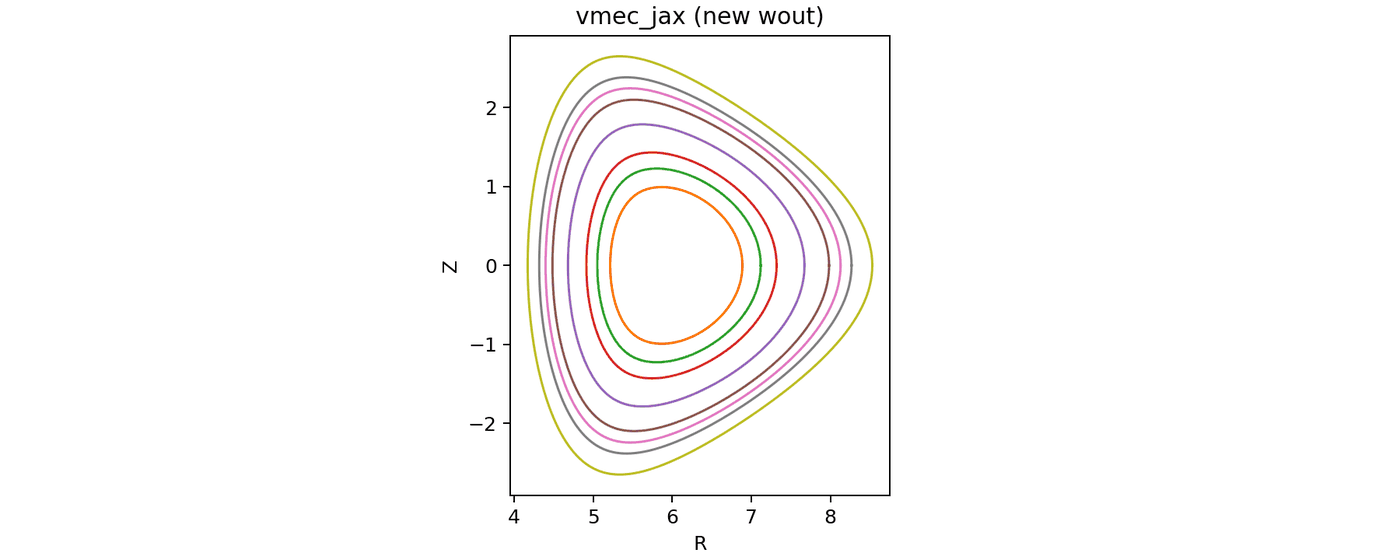
Example output: nested flux-surface cross-sections at phi=0 for the
bundled shaped_tokamak_pressure case.
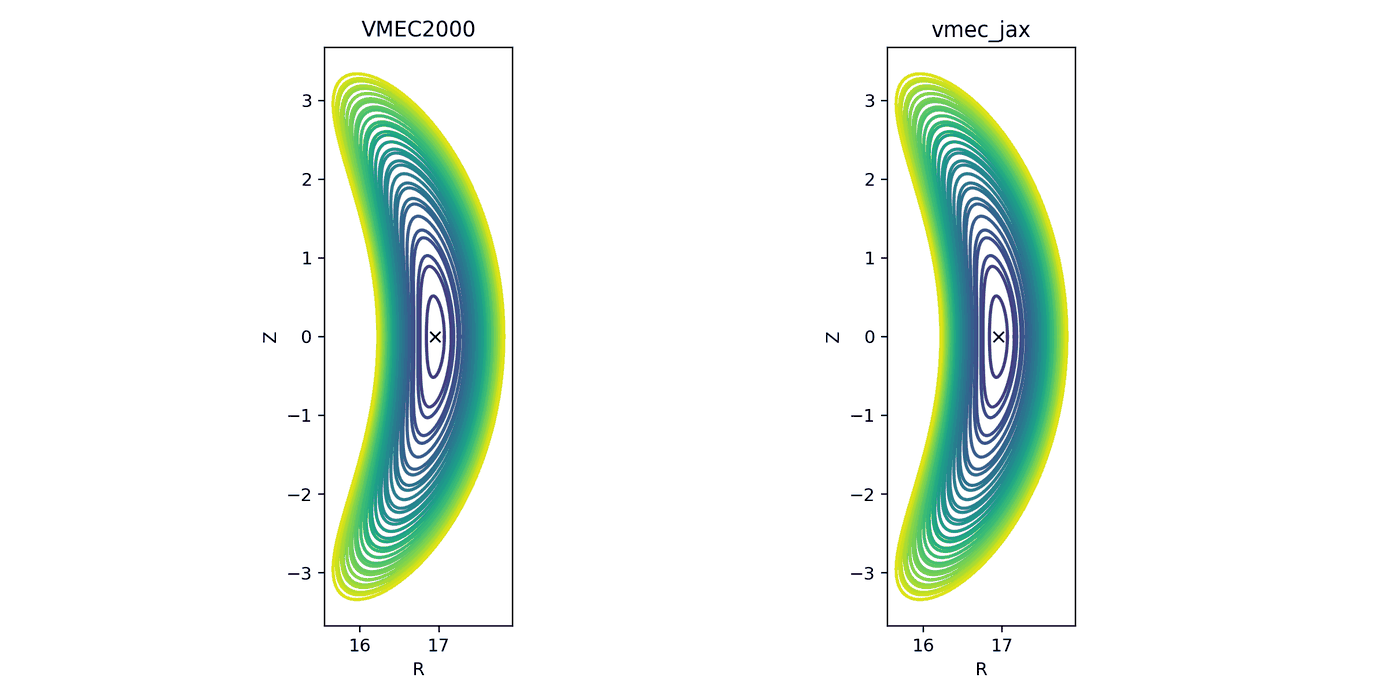
Side-by-side VMEC2000 vs vmec_jax cross-sections for the bundled
LandremanPaul2021_QH_reactorScale_lowres stellarator case.
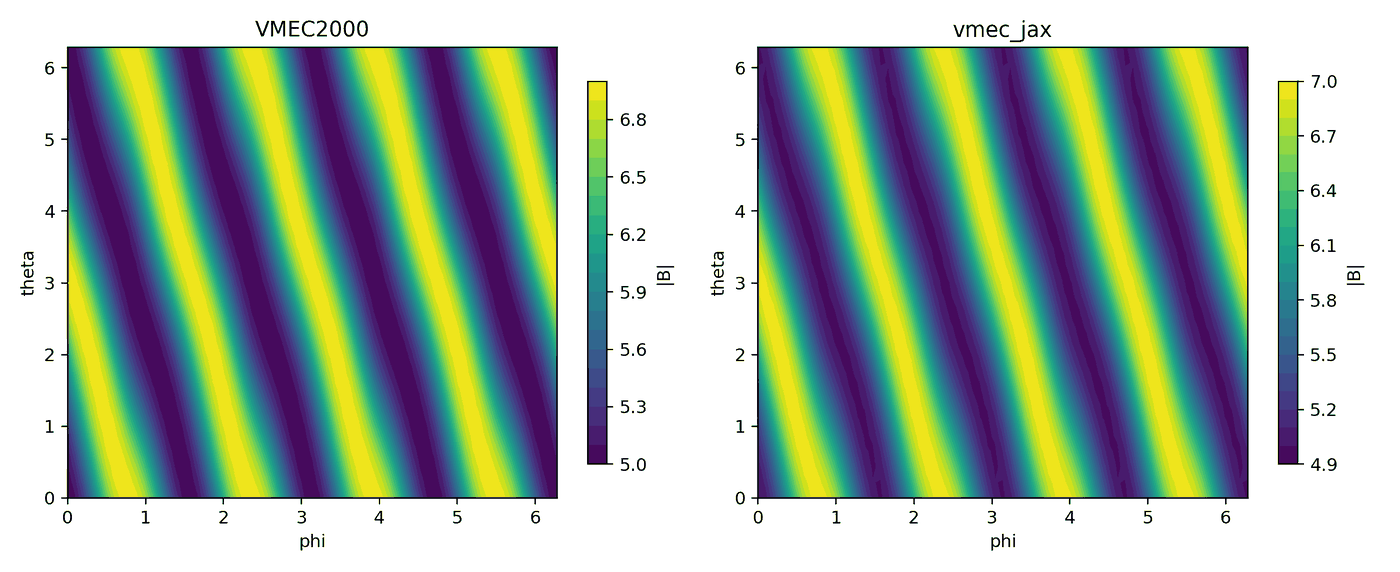
VMEC2000 vs vmec_jax |B| on the LCFS (same VMECPlot2-style grid).
Scope (current)
The validated scope covers the full VMEC branch matrix:
fixed-boundary and free-boundary solves,
axisymmetric (ntor = 0, nfp = 1) and non-axisymmetric configurations,
lasym=Falseandlasym=Truebranches.
For cancellation-limited diagnostics (notably near-axis channels and near-zero denominators), comparisons use the standard axis mask and relaxed interpretation documented in Validation and parity with VMEC2000.
Project state snapshot (March 2026)
This section is a historical snapshot. Use Validation and parity with VMEC2000, Performance notes, and Release checklist for current release claims.
The project has now crossed the point where the main questions are less about “can it run?” and more about “which path should become the long-term stable interface?” The current state is:
Parity: fixed-boundary bundled-reference parity is strong across axisymmetric / non-axisymmetric and
lasym=False/Truebranches. Free-boundary coverage combines bundled-reference gates, convergence-only end-to-end tests, and optional executable-backed VMEC2000 checks.Performance: the fixed-boundary controller now has profiled CPU/GPU policies and lower optimization replay overhead. Single-solve CPU runtime is still a mixed result versus VMEC2000, so broad runtime wins are not part of the current release claim.
Differentiability: explicit and implicit differentiation both work through the public Python API. The next gap is measurement: optimization / gradient cost needs the same benchmark discipline that parity already has.
Ecosystem: the easiest downstream integrations are now through stable
woutoutput and through JAX-native Boozer inputs, not through deeper solver internals.
Initial guess
vmec_jax initializes Fourier coefficients with VMEC-style axis regularity:
rho = sqrt(s) scaling for m>0 modes and a linear blend between axis and
boundary for m=0 coefficients when axis inputs are provided.
When axis inputs are not provided, vmec_jax can recompute an axis guess by
searching each toroidal plane for an axis position that maximizes a minimum
Jacobian proxy on VMEC’s reduced theta grid.
Design principles
Runtime dependencies
The plain vmec-jax package is the supported runtime lane. It installs the
solver, plotting stack, NetCDF I/O, and JAX-native Boozer transform dependency
used by the optimization examples:
numpyjaxandjaxlibnetCDF4matplotlibbooz_xform_jax
The only extras are development/documentation conveniences such as docs and
dev; there is no separate plotting or QI extra for users to remember.
Regression-first development
Released VMEC2000 wout_*.nc fixtures are treated as ground truth for:
Fourier mode ordering and normalization,
Nyquist
sqrt(g)and B-field coefficients,scalar integrals like
wband total volume,scalar residual measures (
fsqr/fsqz/fsql).
Nonlinear iteration parity is tracked separately from kernel parity on reference states (which is solver-free and therefore isolates conventions).
Ecosystem integration direction
vmec-jax now sits in a broader JAX plasma-tool ecosystem. The most useful
integration surfaces to preserve and document are:
wout_*.nccompatibility for tools that consume VMEC outputs directly,booz_xform_inputs_from_statefor file-free in-memory Boozer pipelines,a small public solve/result API (run_fixed_boundary, FixedBoundaryRun, wout_from_fixed_boundary_run) that downstream packages can wrap without importing internal solver modules.
This suggests a practical rule for future refactors:
simplify internals aggressively,
keep the public solve/result / wout / Boozer-export surfaces stable.